Lake of the WeekOn the Water
8 Ways to Spend a Day on Big Green Lake
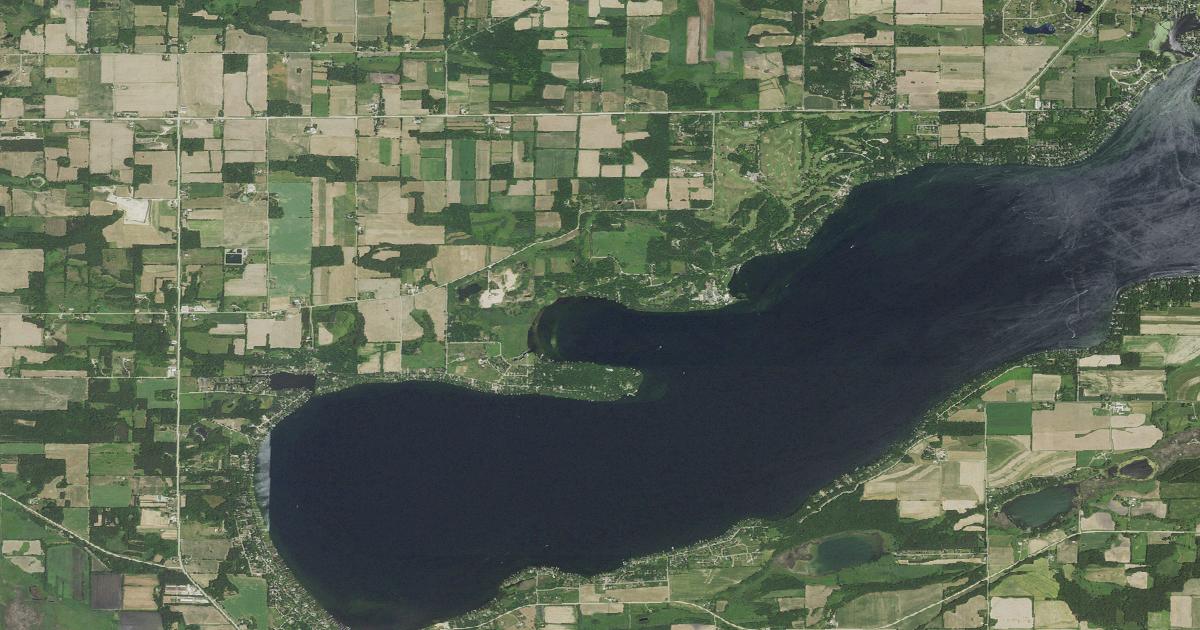
Green Lake is the deepest natural lake in Wisconsin, and the trouble in it is not at the bottom. In 2014 the Wisconsin DNR listed it as an impaired waterbody for a dead zone of low dissolved oxygen in its thermocline — a band roughly 30 to 60 feet below the surface — with excess phosphorus named as the likely cause. The Green Lake Association, which tracks the listing, counts roughly 144 Wisconsin lakes listed for low dissolved oxygen and 718 for high phosphorus. Below that band, this lake keeps going to 236 feet.
Even the basic dimensions are unsettled. The DNR's lake page for waterbody 146100 gives 7,920 acres and 236 feet; the Green Lake Association publishes the same 236 feet but 7,660 acres and a 100-foot average, while the DNR's own 2022 fisheries report puts the mean at 104. Wikipedia says 237 and 7,350. The word carrying the weight in "deepest natural" is natural: Wazee Lake in Jackson County is 355 feet and is the deepest inland lake in the state outright, but it is a flooded taconite mine pit that filled after the Jackson County Iron Mine closed in April 1983 and its dewatering pumps came out. Green Lake's basin is a pre-glacial river valley dammed at its west end by terminal moraines along present-day Highway 73 more than 12,000 years ago, per the Green Lake Association.
Eight things below: the shallow 233-acre bay the DNR report ties to the phosphorus, a lake trout fishery the state has been building since about 1952, three separate launch passes sold by three separate governments, two supper clubs, a 1929 golf course, two markers that put the lake's Ho-Chunk record in the town's own words, and the preserve that opens twice a year. This publishes the week the Green Lake County Fair opens, August 6 through 9, 2026, free general admission, with the truck and tractor pulls and the demolition derby at $15 a head and children 10 and under free, per the county's UW–Madison Extension office (checked Aug 2, 2026).
Start with the shallowest 233 acres, not the deepest 236 feet
The County K estuary, off the southwest end of the lake
The DNR's 2022 comprehensive summary report ties part of Green Lake's phosphorus loading to 233 acres that average less than two feet deep. That is the County K estuary, a bay off the southwest end, where common carp keep the bottom stirred up. The DNR installed a carp barrier there in 2009. It has been retrofitted repeatedly, and the same report proposes replacing it.
That shallow water is one end of a chain the report draws itself. The other end is that thermocline band, and the 2014 listing recorded on the Green Lake Association's impairment page is for it — not for the bottom of the lake.
Fish for a lake trout the state has been building since about 1952
The main basin, from any of the eight DNR-listed landings
Lake trout were first introduced to Green Lake around 1952 and have been stocked most years since. The DNR's 2022 report is blunt about what that means: the fishery "is primarily supported through stocking with little to no natural reproduction documented over the years." A coded wire tagging project began in 2015, the first tagged fish went in during 2016, and every fish stocked since carries a nose tag and a clipped adipose fin. Heads and carcasses turned back in are how the state knows the rest. Fish go in a little over a year old and take an average of four years to reach the 17-inch legal size.
The 2022 gill-net sample handled 186 lake trout averaging 23.9 inches against a long-term average of 21.5, ranging from 12.5 to 37.3. Of the fish with anything in their stomachs, 79 percent had eaten freshwater shrimp. Green Lake also still holds cisco, the native cold-water forage fish historically reported from 188 Wisconsin lakes and found in only 94 during a 2011–2014 survey. The DNR notes that as nutrients and temperatures rise, "their existence could be challenged." A more restrictive cisco regulation took effect in April 2020, after concerns were raised at public meetings in 2015.
Before you go: Legal size on lake trout is 17 inches, which the tag returns put at an average of four years in the water. Cisco rules tightened in April 2020. The DNR also notes that winter 2022–23 gave Green Lake little to no safe ice, normally the season of heaviest lake trout pressure.
Buy the right launch pass, because there are three
Dodge Memorial County Park and Sunset Park (county); Park Drive, Canal Street and Hattie Sherwood (city)
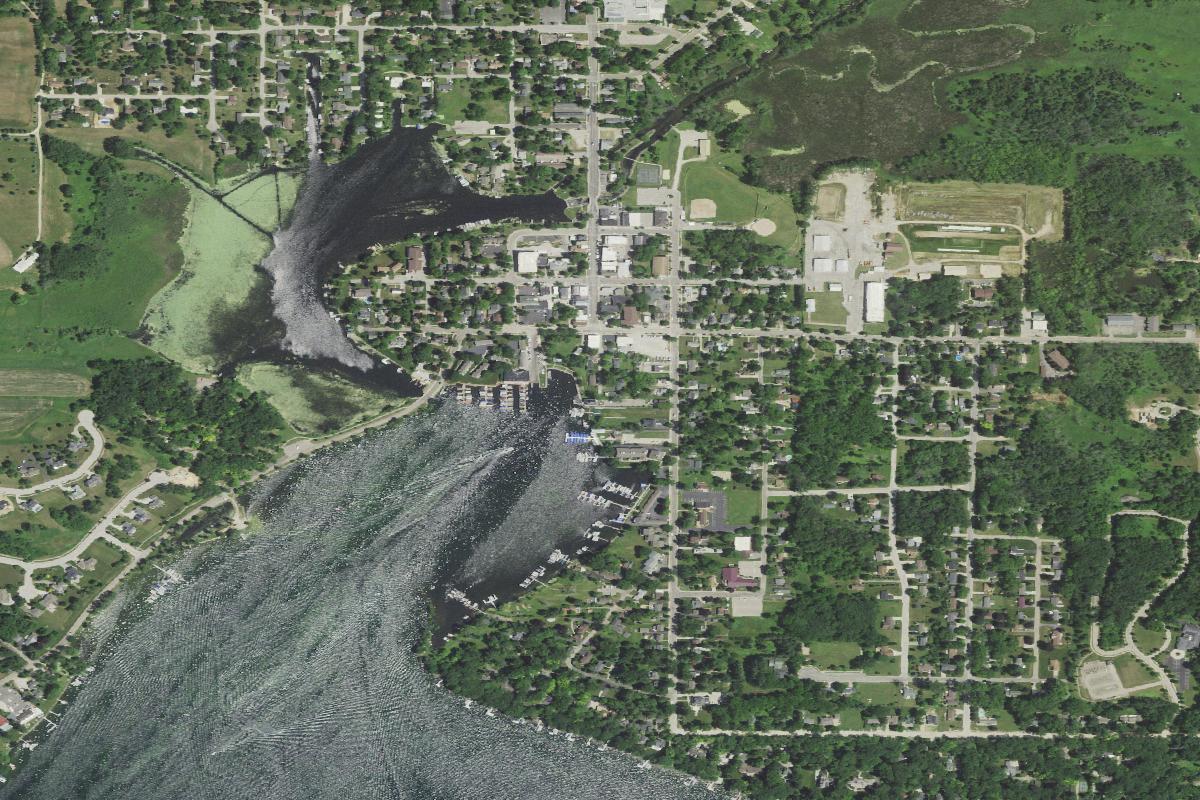
The village of Green Lake and its harbour, at the east end of the lake. USDA NAIP via USGS (Public domain) The DNR counts eight boat landings and three designated beaches on Green Lake. What it does not count is the number of governments selling launch passes, which is three; all three schedules below were checked Aug 2, 2026. Green Lake County charges $30 a year for residents and $40 for nonresidents, plus a $7 daily permit, at Dodge Memorial County Park and Sunset Park; the annual term runs April 1 to March 31, and four more county parks were added for 2026. The City of Green Lake sells its own — $7 daily, $31 resident, $41 non-resident — for the Park Drive, Canal Street and Hattie Sherwood launches. Horner's Landing and the Little Green Lake landings answer to a third government. The Town of Green Lake charges $30 for a first vehicle and $5 for each additional. Little Green is a different lake.
If the boat is already wet, there is one dock nobody charges for. Waves Pub and Grill at the Heidel House tells boaters on its own page to "pull up to our free public dock," and runs its Friday fish fry from 4 to 11 p.m. (Waves Pub and Grill, checked Aug 2, 2026).
Before you go: None of the three passes covers the others, so buy against the ramp you actually plan to use. The county's annual term runs April 1 through March 31, which means a county annual bought in March buys you weeks rather than a year.
Eat at Norton's, then walk over and read the propeller
Supper club380 S. Lawson Dr.; the marker is at 485 Park Dr.
Norton's has fed people on this shoreline since 1948. It calls itself the only lakefront restaurant with its own dock, where guests "can arrive by land or lake," and it runs a Dock Bar its site calls seasonal. The published weekly schedule names two dishes: Friday is the Classic Wisconsin Fish Fry, Saturday the prime rib special with live music. Wednesday, kids eat free. Thursday is half off bottles of wine.
The name is about fifty years older than the restaurant. A few blocks away, at 485 Park Drive, a propeller is mounted on a marker, and the inscription — transcribed in the Historical Marker Database as marker 200423 — says it came off the Queen of the Lake: at 100 feet in length, "the largest of five steam boats and boat launches operated by the Norton Family on Big Green Lake." It was built near that site in the mid-1890s, burned coal and wood, and ran "Round the Lake" excursions until the late 1920s. The marker went up in 2022, a gift from Robyn and George Mockus on behalf of Norton's Dining Room.
The ownership changed this summer. Gage Marine Corporation announced on June 15, 2026 that it had bought the place; it is a third-generation Wisconsin family company that describes more than 150 years of lakefront hospitality and marine heritage, and it is best known on Lake Geneva. Announced terms keep the Norton's name, the Est. 1948 heritage, the menu classics and the existing team, with no interruption through the summer 2026 season, and both Gage COO FJ Frazier and prior owner Joe Pregont went on record. Trade coverage said it would operate as "Norton's by Gage." As of August 2026 the restaurant's own site still brands solely as Norton's of Green Lake.
Before you go: Closed Monday. Tuesday through Thursday 4 to 10 p.m., Friday and Saturday 11 a.m. to 11 p.m., Sunday 11 a.m. to 10 p.m., off the restaurant's own site and checked Aug 2, 2026. Reservations run through SevenRooms; the number is (920) 294-6577.
Drive to Princeton for prime rib named after the owners
Supper clubW720 Hwy 23, Princeton, about 12 miles from Green Lake
Paul and Leanne Harvey started an outfitting business on the Mecan River in 1984, added the lodge in a major 1994 expansion, and in January 1997 built a separate dining room with its own large fieldstone fireplace. The week there is as fixed as the week at Norton's, and it runs on a published nightly format.
Thursday is Mecan River Country Fried Chicken. Friday night is a Cod Platter, a Walleye Platter or Poor Man's Lobster, each served with coleslaw, French fries and rye bread. Saturday is slow-roasted aged prime rib in two sizes named for the owners: Paul's Cut at 16 ounces, Leanne's Cut at 10. The appetizer list carries the "Beaver Dam," which the menu describes as a heaping mound of homemade onion rings, sold as a half or a full mound and explicitly not available on Friday nights.
Before you go: The lodge's site, checked Aug 2, 2026, lists dining closed Monday and Tuesday, Wednesday 4 to 8, Thursday 11 to 8, Friday 11 to 9, Saturday 8 to 9, Sunday 8 to 2, with breakfast only Saturday 8 to 11 and Sunday 8 to 11:30. That page carries a 2023 copyright, so call 920-295-3439 and confirm the hours before you drive out.
Play a 1929 course built on a Chicago newspaper fortune's land
Lawsonia, Green Lake; Tuscumbia Golf Course, 680 Illinois Ave.
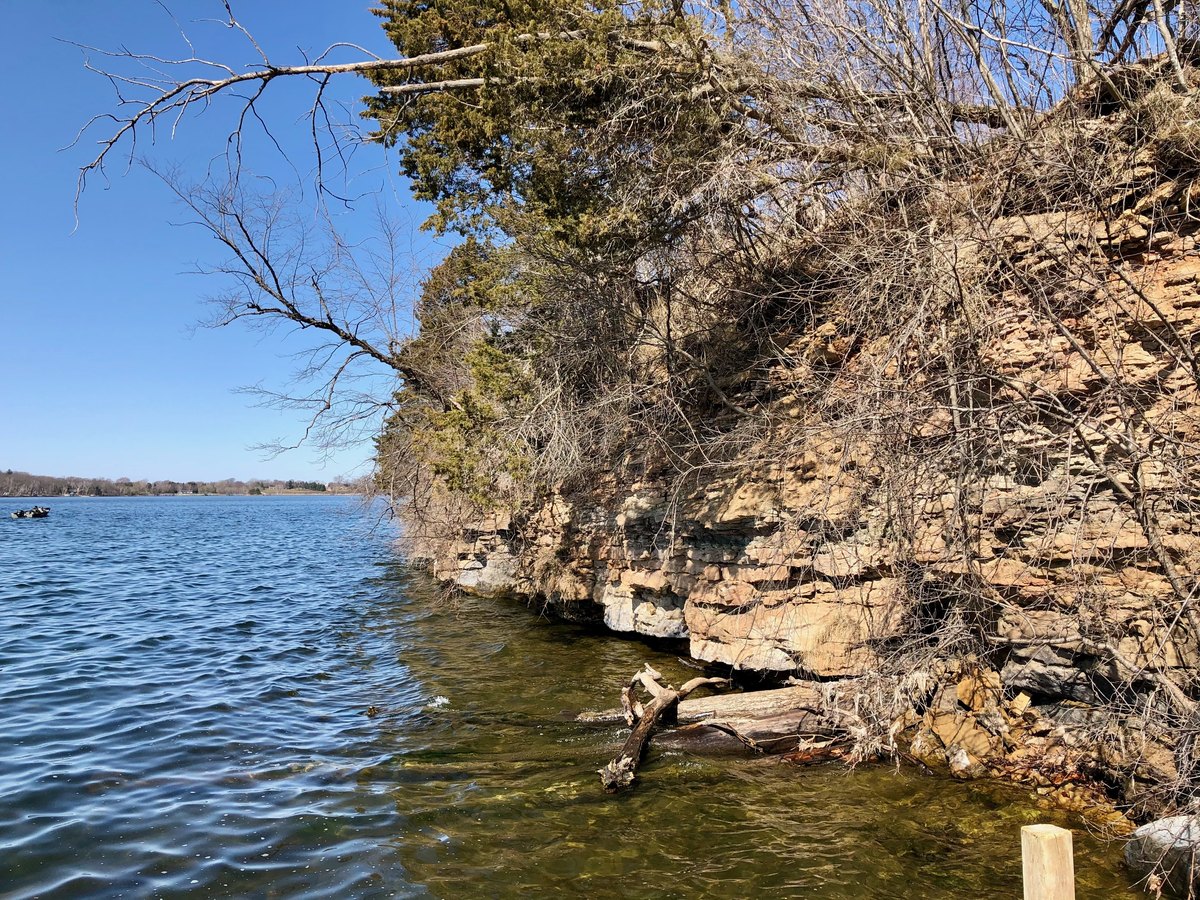
The shoreline at Lone Tree Point — the name the Lawsons gave their farm here. Wideshpan6 via Wikimedia Commons (CC BY-SA 4.0) The Links course at Lawsonia was laid out in 1928 by William Langford and Theodore Moreau, who had formed their design partnership in Chicago in 1918 and one of whom, Moreau, was a civil engineer. It was completed in the spring of 1929 and dedicated in May 1930 as a reported $250,000 course. The routing is unusual: five par 3s, five par 5s and eight par 4s. One of those par 3s, the 7th, is called the Boxcar hole, and Golf Club Atlas is explicit that this is lore rather than fact — a boxcar is "allegedly buried beneath the elevated green." Three miles away, Tuscumbia Golf Course at 680 Illinois Ave. carries a claim of its own: Travel Wisconsin bills the 1896 course as Wisconsin's oldest. That superlative is the tourism board's. Tuscumbia's own site claims the date and not the title.
The land came from a newspaper. Victor and Jessie Lawson, he the publisher of the Chicago Daily News, honeymooned at Green Lake and bought their first 10 acres in 1888, building the property into an estate they called Lone Tree Farm. After they died the land went to Chicago's H.O. Stone Company in 1925, which spent $3 million turning it into a gated resort: the Roger Williams Inn in 1930 with 81 guest rooms, a dining room, a bar and a casino, an outdoor pool, 25 homes, and the Links. The 1929 crash killed it.
In December 1943 the Northern Baptists bought the estate, appraised at $11 million, for $300,000, and held their first conference there in June 1944. That same summer about 400 German prisoners of war were housed on the grounds, June to October. Dr. Martin Luther King Jr. spoke there on July 23, 1956.
Read the Ho-Chunk record off two markers within half a mile of each other
Lake St. at Illinois Ave., and Hattie Sherwood Park, 459 S. Lawson Dr.
At Lake Street and Illinois Avenue, a marker gives the lake its older name. It states that the people who occupied this land 10,000 years before European settlers called it Daycholah, that "from lookouts like this" they viewed the water and paid homage to "the spirit who dwells beneath the water," and that an open square earthwork the marker calls unusual, built circa 1000 A.D., once stood near that spot. It was lost to development, in the marker's words, along with many of the burial mounds that ringed the shore.
Less than half a mile away, in Hattie Sherwood Park, a marker erected in 2025 by George W. King tells one man's story. Chief Highknocker — Ho-Chunk name Hanageh, son of Chief Big Soldier — was born in 1820 in his father's camp on the east shore and was nicknamed for the old top hat he wore. After the tribe was moved to a reservation he returned to Green Lake every summer. On Saturday, August 12, 1911, at age 91, he collapsed and drowned trying to swim the Fox River to his camp. He is buried in Dartford Cemetery.
One institution on the lake has taken the name back. The former Pilgrim Center camp became Daycholah Center effective September 9, 2021, after a three-year listening process led by members of Ho-Cak UCC in Black River Falls with counsel from the Ho-Chunk Nation, and it was rededicated on Indigenous Peoples' Day, October 11, 2021.
Before you go: Hattie Sherwood Park at 459 S. Lawson Dr. is also one of the three launches the City of Green Lake sells its own pass for, so putting a boat in there parks you at the Highknocker marker.
Walk the preserves, including one that opens twice a year
Norwegian Bay Wetlands, Bay Road trailhead; Winnebago Trail trailhead near the Lawson water tower, Hillside Rd.
Mitchell Glen is, in the Green Lake Conservancy's words, "accessible only during two annual guided hikes." The rest of the conservancy's properties are open. Hammer's Trail, on the Assembly Creek and Springs property, is a two-thirds-mile walking loop with six bridges over creeks and springs. The Norwegian Bay Wetlands Boardwalk winds through wetland to the shore and can be reached from a Bay Road trailhead or by boat from Norwegian Bay.
The Winnebago Trail Conservancy runs the north shore through southern oak forest and remnant prairie, following what the Conservancy describes as a former Native American trail on the elevated shoreline, and passes under a large 110-year-old stone and concrete arch near its east end. Its trailhead sits near the historic Lawson water tower on Hillside Road. For paddlers, the Silver Creek Water Trail links six conservancy properties, with launches at Spaulding's Bridge Landing and the Green Lake Sailing School.
Before you go: Mitchell Glen opens for two guided hikes a year and is closed the rest of the time, so it is never a walk-up.
One claim we are not printing as fact: that Green Lake is the oldest resort community west of Niagara Falls. It rests on the Oakwood, a hotel David Greenway opened in 1867 on 35 acres with lakefront and a vineyard, which started at a maximum of 75 guests and eventually took 300 a night before it was demolished in 2012. The Ripon Commonwealth Press asserts the Niagara Falls line on its own account, without a source. Larry Behlen, president of the Dartford Historical Society, is quoted in the same story making the narrower claim that the Oakwood was the first resort for Green Lake, before the city was even called Green Lake. The city dates the town's founding to 1847, as the village of Dartford. The surviving Greenway House became a bed and breakfast in 2016, with rooms named Deacon Mills, Oakwood and Dartford. Everything else above traces to a named source, checked August 2, 2026 — first-party where a first-party page exists, and named where it is not (Wikipedia, Golf Club Atlas, the Historical Marker Database), because hours and seasons move. If we have something wrong, tell us and we will fix the page.