Lake of the WeekOn the Water
8 Stops Around Lac Courte Oreilles, Starting With a Disputed World Record
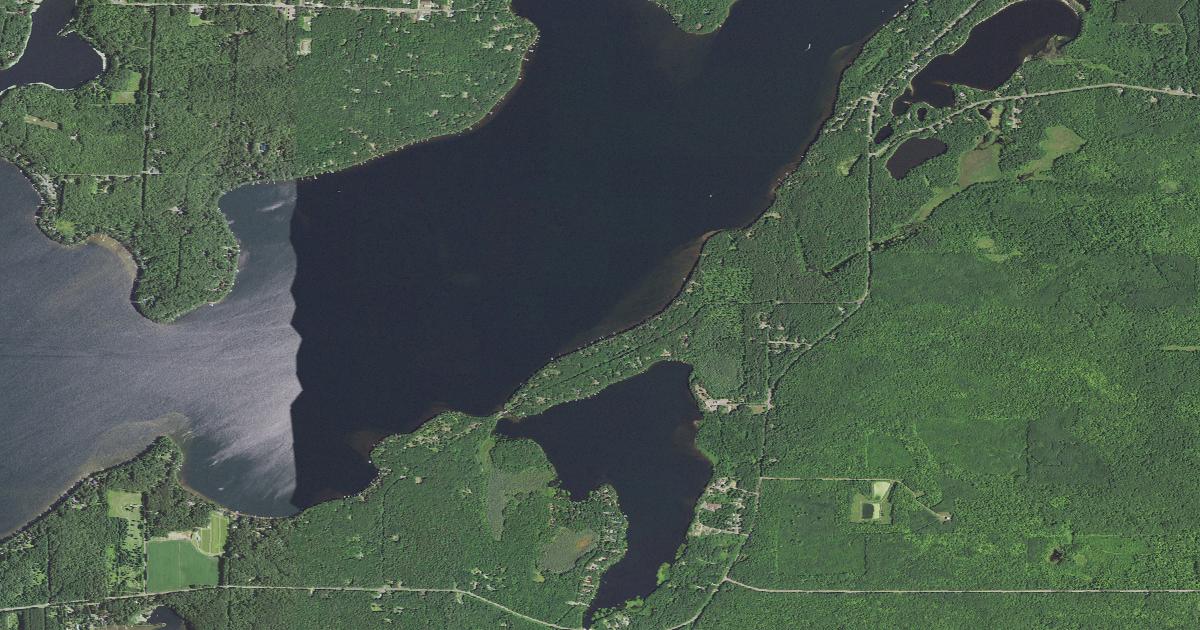
Lac Courte Oreilles produced the fish the International Game Fish Association still lists as the all-tackle world-record muskellunge: 67.5 pounds, caught by Cal Johnson on July 24, 1949, by the Sawyer County Record's account. It also produced a long argument, still unresolved, about whether that fish was ever the 60.25 inches on the record. The evidence on both sides is the first stop below.
The lake under the argument is the half that can be measured. It is a deep, stratified two-story basin, cold enough down low to hold self-sustaining cisco and lake whitefish — one of only five inland lakes in the state that hold both, by the Courte Oreilles Lakes Association's count. The measurements, and the two sources that disagree about them, are the second stop.
Eight stops below. The bar where the mount hangs and the squirrels play cards, the three-foot band of cold water COLA puts at 34-37 feet in August 2011, a supper club that opened in 1931 as The Aladdin, a village drowned in 1923 and the last two known survivors of it, honored ninety years later, a floating peat island the neighbors move with boats, and a 143-foot fiberglass muskie you can stand inside.
See the record, then decide whether you believe it
Moccasin Bar, 15820 US Hwy 63, Hayward
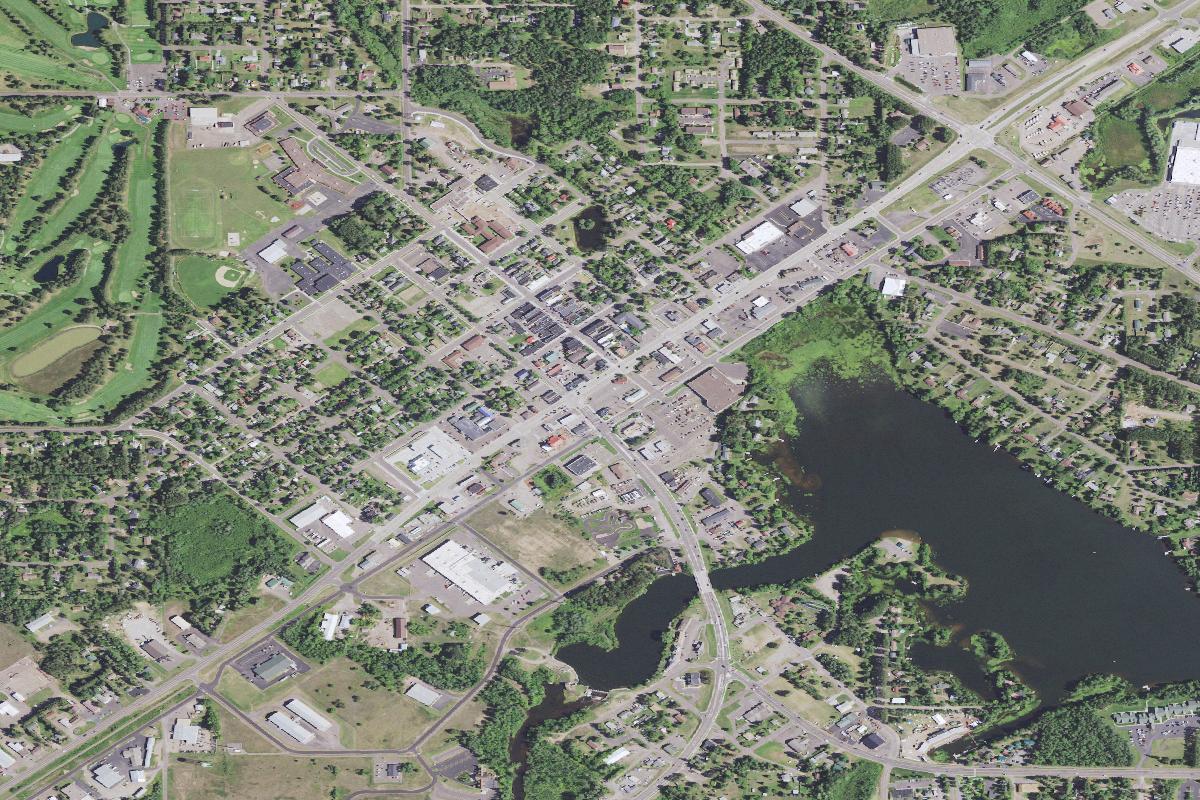
Downtown Hayward. US 63 runs through the middle of it. USDA NAIP via USGS (Public domain) The Moccasin Bar on Highway 63 is a working bar that doubles as a small wildlife museum. The downtown business directory calls it 'a fun northwoods atmosphere with a nostalgic taxidermy twist of furry creatures and fish lining the walls preserved behind glass.' What that means in practice is dioramas: squirrels, chipmunks and other small mammals staged in human scenes, playing cards and drinking beer. The dioramas are not the only thing behind glass. Cal Johnson's muskie hangs here too.
Cal Johnson caught it on Lac Courte Oreilles on July 24, 1949, by the Sawyer County Record's account. It weighed 67.5 pounds, measured 60.25 inches, carried a 33.5-inch girth, and the International Game Fish Association still lists it as the all-tackle world record. In June 2008 the World Record Musky Alliance had DCM Technical Services apply photogrammetry to the surviving photographs and argued the fish was no longer than 52 inches. The IGFA refused to rescind in February 2009. Its conservation director: 'We simply do not feel that the photogrammetry analysis is sufficient for us to rescind this record.'
The defense is as specific as the attack. Emmitt Brown argued the mount itself settles it, since 'There's not one disruption of the scale lines running back and forth,' and musky historian John Dettloff bought an identical rod and produced a previously unpublished photograph of Johnson with the fish and that rod. Even the date is contested. The Sawyer County Record says July 24, 1949; the Downtown Hayward business directory says July 14; the newspaper's own headline says 1947 while its body text says 1949.
Before you go: No hours are published on any source we could verify, so (715) 634-4211 is the call to make before you drive over.
Read the lake as two lakes stacked on each other
The main basin, and the DNR's file on it
Lac Courte Oreilles is a deep, stratified two-story lake: a warm upper story, a cold lower one, and species that need one or the other. By the Courte Oreilles Lakes Association's count it is one of only five inland lakes in Wisconsin with self-sustaining populations of both cisco and lake whitefish. 'There are only five such, inland lakes in the entire state.' The lower story can get very thin. COLA's own illustration uses August 2011, when 'the first floor (lower story) is just a 3 foot band at 34-37 feet,' and the association credits that cold-water forage base as one reason the lake 'consistently produces such big fish, including world-class muskellunge.'
The DNR's official figures read 5,139 acres, 90 feet at the maximum depth, water clarity 'very clear,' three public boat landings, northern pike abundant, and musky, walleye, smallmouth and panfish common. COLA's own page reads 5,039 acres and 95 feet. We could not find a source that reconciles them. We use the DNR's and note the disagreement.
That thin cold layer is also a regulatory object. Wisconsin's general standard for total phosphorus is 15 parts per billion; the most protective criterion in the state is 10 ppb (10 μg/L), codified in NR 102.06 for two-story fishery lakes, and COLA states the DNR has applied it here. COLA and the Lac Courte Oreilles Band sued the DNR over phosphorus limits, and WPR reported on April 18, 2017 that the agency had agreed to study the lake and investigate a stricter site-specific limit. The lake association's own study found the lake would benefit at 10 ppb. What preceded all of it was a mass die-off of cisco and whitefish the previous year.
Take the name apart, and accept that nobody has settled it
Odaawaa-zaaga'igan, and the bays that may explain the French version
The lake has two names. In Ojibwe it is Odaawaa-zaaga'igan, 'Ottawa Lake,' and the Lac Courte Oreilles Band calls itself the people of Odaawaa-Zaaga'iganiing. French traders rendered it Lac Courte Oreilles, 'Lake of the Short Ears.' That translation is where the trouble starts.
Three explanations circulate and none of them is settled. The Courte Oreilles Lakes Association offers two: that 'a local band of Ottawas observed the custom of cutting off a portion of their ears – hence the name,' and that 'others suggest the name came from the several ear-like shaped bays on the lake such as Musky and Stuckey bays.' Wisconsin First Nations gives a third, that the French used the name because 'their ears were not stretched like other Ojibwe who wore heavy earrings.' From above, the bays make the second one easy to picture. That is not evidence.
Before you go: Musky Bay and Stuckey Bay are both named on the lake, and the DNR record lists three public boat landings for reaching them.
Order a steak at a place that opened in 1931 as The Aladdin
Supper clubThe Ranch, 10590 N Ranch Road, Hayward
The Ranch is the sit-down dinner in this piece. Its own history page claims the 1931 room as a 'favorite Northwoods stopping place' for early lumberjacks, timber tycoons and Chicago gangsters, and tells stories of federal agents disguising themselves as waiters in hopes of arresting a diner. That is the restaurant's account of itself, and no independent record confirms it. The ownership arc comes off the same page. It became The Ranch in 1960 under proprietress Vivian Levinson, who kept bison, a deer farm and a sway-backed horse on the property.
In 1987 Beth and Barney Morgan went into partnership with Cheryl Haupt 'to run the classic supper club for the ensuing 30 plus years,' by the restaurant's account the longest standing ownership it has had. Haupt died on September 23, 2016. It is now owned by the Morgans' daughter Haley Bochler, a Certified Sommelier who was lead captain at Addison in California, and her husband Nathan, who cooked at San Diego's Indigo Grill, a restaurant featured on Food Network.
What is actually on the plate, per Travel Wisconsin's December 2025 write-up: steaks with walnut bleu cheese butter and onion rounds, and a relish tray that runs to herring and cheese spread. The reservation policy is published in the restaurant's own words: 'Reservations always recommended, but never required.'
Before you go: Open year-round Thursday through Sunday at 5 p.m. on the restaurant's own site, which asks you to call for holiday and seasonal closures: (715) 634-2090. The Ranch is not on Lac Courte Oreilles and has no boat access, so this is a drive, not a cruise.
Look east, and know what is under the flowage
The Chippewa Flowage, 15 miles east of the lake
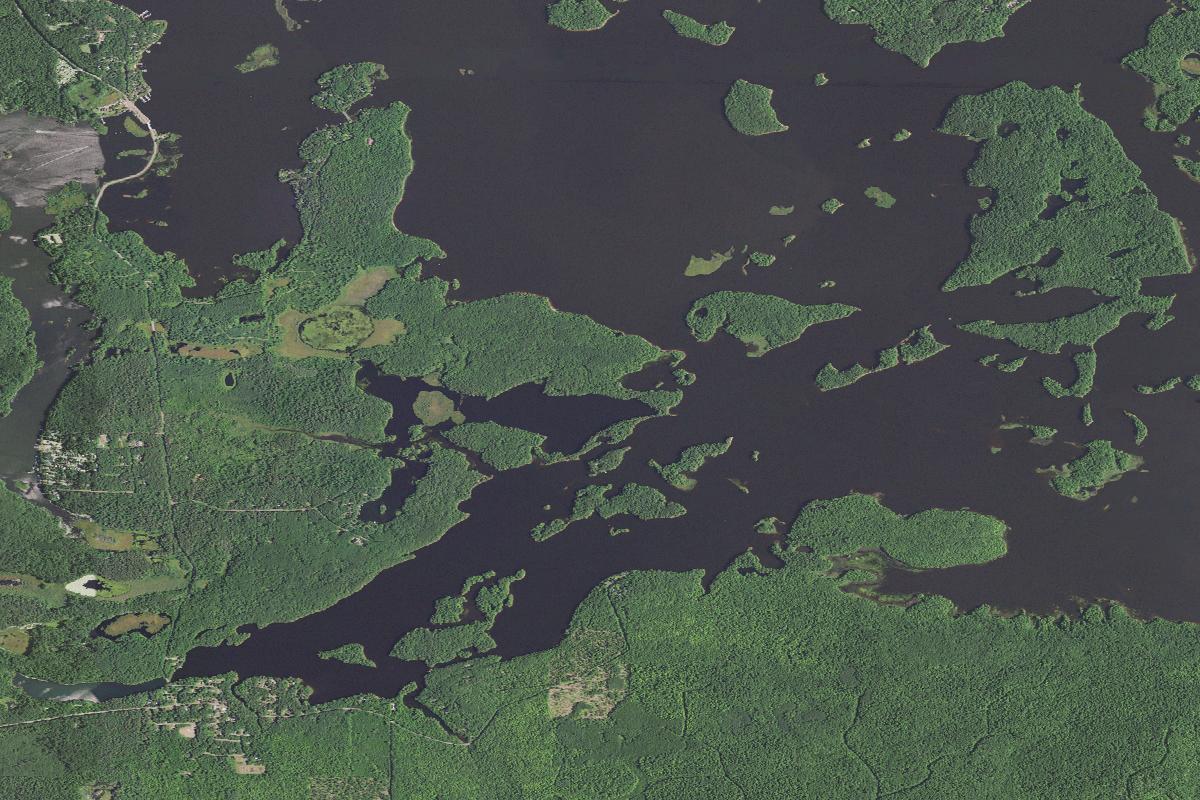
The Chippewa Flowage east of Hayward — islands, bogs, and the drowned ground between them. USDA NAIP via USGS (Public domain) Fifteen miles east of the lake there is a village under the water. Pahquahwong, rendered by the Sawyer County Record as 'Where the River Bends' though other sources say 'Where the River is Wide,' was known in English as Post. It had an estimated population of 180 in the early part of the 20th century, the second-largest community on the Lac Courte Oreilles reservation, with a Catholic church and a cemetery. The Winter Dam gates closed on March 15, 1923. The flowage was declared full on August 1 of that same year.
What went under was homes, gardens and wild rice beds that had been yielding about 25,000 pounds of rice a year. Replacement houses 'were built as quickly as possible from green lumber supplied by the power company.' The graves were moved. One account of that is hard to improve on: 'when the graves were dug up, people would sit on the top of the hill and watch.' The abandoned Catholic church 'stood intact for many years on high ground.'
On August 1, 2013, ninety years to the day, a ceremony on Loon Cove Island honored the last two known survivors of the village. Sam Jockey was 92, Phyllis DeBrot 93. There were prayers, speakers, honor songs and a venison stew feed.
Before you go: The flowage itself is 15,300 acres on the DNR record, with about 200 undeveloped islands and 233 miles of shoreline, and the DNR calls it Wisconsin's third-largest lake. Boat-in primitive campsites are available on it.
Go to a powwow that started as a protest against a dam
Honor the Earth powwow grounds, 8575 N Round Lake School Road
When Northern States Power's license for the Winter Dam came up for renewal in 1971, Lac Courte Oreilles tribal members allied with the American Indian Movement occupied the dam. The standoff ended in a negotiated settlement with NSP and the federal government. A protest powwow held at the old Round Lake powwow grounds in connection with the takeover was organized as a commemorative event in 1972, and it is still held every July on those same grounds. The tribe's own venue page has the 53rd annual Honor the Earth Homecoming Celebration and Powwow running July 17 to 19, 2026.
Three years after the occupation, two brothers made themselves into a test case on purpose. Per WPR's account of the case, Fred and Mike Tribble, both Lac Courte Oreilles members, fished off-reservation in 1974 specifically to force one. State wardens arrested them for harvesting without a state license and a Sawyer County judge convicted them. The tribe sued Wisconsin in federal court in 1975. U.S. District Judge James Doyle Sr. ruled against the band in 1978, holding that the 1854 treaty had extinguished the rights.
The Seventh Circuit reversed in 1983. Lac Courte Oreilles Band of Lake Superior Chippewa Indians v. Voigt, 700 F.2d 341, found that the 1837 and 1842 treaties had expressly reserved hunting, fishing and gathering rights on ceded land. Spearfishing resumed under a negotiated agreement in 1985, and the boat-landing confrontations that followed, with rocks, bottles and racist threats aimed at Ojibwe spearers, became known nationally as the Walleye Wars. The case that reopened treaty rights across northern Wisconsin carries this band's name.
Before you go: Honor the Earth is held every July at 8575 N Round Lake School Road, about nine miles southeast of Hayward, per the tribe's venue page. We could not source a published duration for it, so confirm the schedule with the LCO tribal office before you build days around it.
Ask where the bog is before you plan the day
The bridge between the east and west sides of the Chippewa Flowage
The flowage carries a free-floating peat bog large enough that a volunteer fleet periodically has to push it out of the way. When the water came up in 1923, peat mats detached from the bottom as gas accumulated under them and rose as free-floating islands. The big ones carry mature trees, including 40-foot tamarack. When one drifts against the bridge between the east and west sides it effectively splits the lake in two, and people turn out with their own boats to shove it clear. Twenty-five boats did it in May 2022; on an early June morning in 2024, forty to fifty turned out.
Denny Reyes, who owns The Landing Restaurant and Resort, told Northern News Now it is 'one of the first things you look for when you come in here in the morning: Where's the bog?' Homeowner Greg Kopke described the technique: 'You can go all summer, and sometimes it doesn't happen. But when we move it, you gotta get it kind of in the right spot, or it can be back in in a couple of days.'
Before you go: Nothing about this is scheduled and there is no guarantee of seeing it. Kopke's own line is that it can go all summer without happening. The agency position, per Northern News Now, is that 'Being a natural habitat, the DNR would rather you leave it be and let Mother Nature take charge of it.'
Climb into the jaw of a 143-foot muskie
National Fresh Water Fishing Hall of Fame, 10360 Hall of Fame Drive, Hayward
The 'Shrine to Anglers' is a muskellunge 143 feet long, built in 1976 of concrete, steel and fiberglass, standing over an 88,000-gallon pond. The Hall of Fame's own measure of it is half a city block long and four and a half stories tall. The open jaw is an observation deck. It holds about twenty people, looks out over Lake Hayward and the town, and has on occasion been used for weddings.
The fish is one piece of a larger complex: 25,000 square feet across seven buildings on six acres. The Hall of Fame itself was founded in 1960, sixteen years before anybody built a four-and-a-half-story fish over a pond in its yard.
Before you go: The published 2026 season is daily, weekends and holidays included, April 15 through October 31, closed November 1 to mid-April. Hours run 9:30 a.m. to 4:30 p.m. in June, July and August with last entry at 4:00, and 9:30 to 4:00 in April, May, September and October with last entry at 3:30. Admission is $9.95 for adults and $7.95 for children 4 to 17, free under 4 and free for active military. (715) 634-4440.
Everything above traces to a named source, and to a date wherever the source publishes one, because hours and seasons move and because this lake has a habit of generating disagreements rather than settling them. Five are still open on this page: whether Cal Johnson's muskie was ever 60.25 inches, which day in July 1949 he caught it, whether this basin is 5,139 acres and 90 feet deep or 5,039 and 95, what came of the phosphorus study the DNR agreed to run in 2017, and who did the taxidermy in the Moccasin Bar. Settle any of them and we will fix the page. Three claims we checked and left out: that the Moccasin Bar is Hayward's oldest building, which traces only to travel writeups with no designation record behind it; that the lake's name goes back to Radisson around 1659, which appears on neither cited source and which the tribe's own history page complicates by dating the Radisson and Groseilliers journey to 1661-62; and a Friday fish fry at The Ranch, which we could not find published anywhere and are therefore not describing.
All the data for Lac Courte Oreilles — depth map, surveys, launches