Lake of the WeekOn the Water
8 Stops and Stories Around Lake Winnebago, Starting With a Rejected Lighthouse
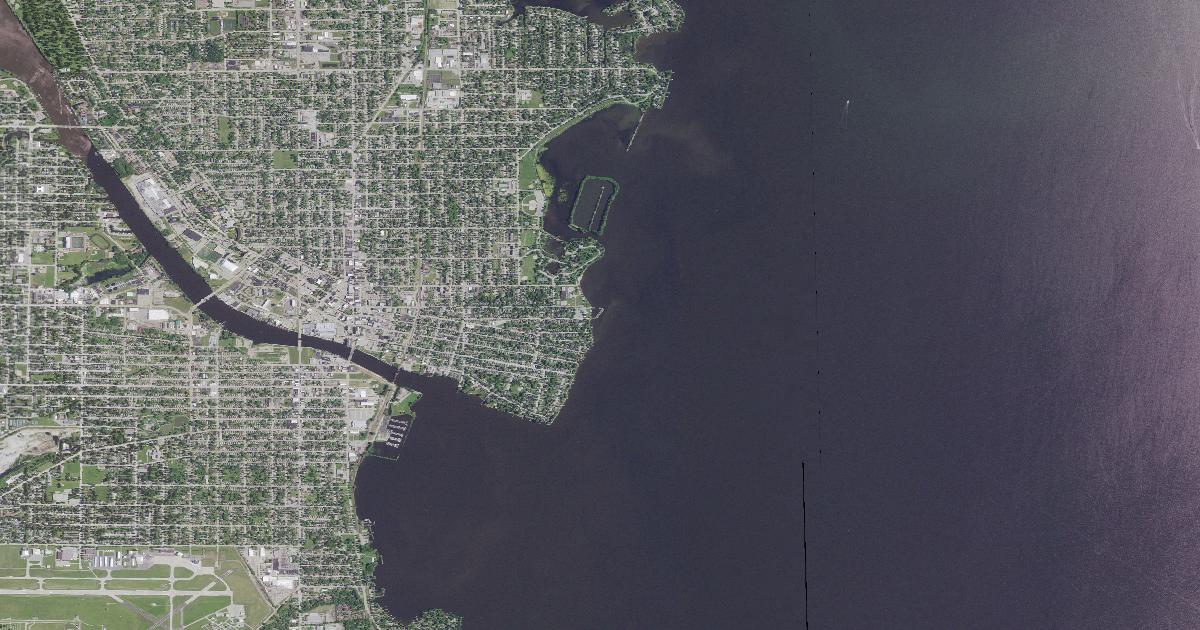
Wisconsin will let you spear a Lake Winnebago sturgeon through a hole in the ice. It will not let you register it over the phone. A speared fish has to be presented in person at an official registration station by 2 p.m. the same day it is taken, and the DNR's 2026 Lake Winnebago station list gives those stations by name and street address — a supper club at Pipe, Wendt's Marine at Van Dyne. That rule is why the 2026 tally is a physical object: 1,540 fish system-wide, every one of them carried to a counter.
The lake underneath that ritual is managed water. Its level has been set by federal order since 1886, held between 1.68 and 3.45 feet on the Oshkosh Datum through the navigation season and deliberately drawn down every winter. The Fox-Wolf Watershed Alliance calls the basin feeding it the largest drainage to Lake Michigan and the third largest in the Great Lakes, and cannot quite settle on its size: one of its pages says over 5,900 square miles, another says over 6,000.
Eight stops and stories below: a Works Progress Administration lighthouse the government would not approve, the caviar prosecution that cost the DNR's lead sturgeon biologist his job, a company town the state turned into a park, effigy mounds at two parks with the Calumet County group sited at the top of the Niagara Escarpment, and two lakeside kitchens — a supper club the DNR lists as its Pipe station, and a fish-fry restaurant whose property carries another one.
Start at a lighthouse the government would not approve
Asylum Point Park, north of Oshkosh
The round stone tower on the small island at Asylum Point went up in 1937 as a Works Progress Administration project, and the Department of Transportation then rejected it as an aid to navigation. It was never electrified. A kerosene lantern was burned in it anyway, visible about 12 miles out on a clear night, to guide local commercial fishermen home. Nobody agrees on how tall it is. Fox-Wolf puts the tower over 24 feet; Wikipedia and us-lighthouses say 30. The seven-foot copper-topped cupola once carried a flagpole that brought the whole thing to 42 feet, and a copper fish weathervane stands where that flagpole was.
In 2007 the tower got a $4,000 restoration — replaced wooden lantern-room components, refitted windows, a rebuilt metal roof — with labor supplied by inmates from the Winnebago Correctional Institute. Ice shoves destroyed the footbridge to the island in 2019, and a new bridge has since been built. The point itself is named for the Northern Asylum for the Insane, begun on this promontory in 1871 and now the Winnebago Mental Health Institute.
Before you go: Winnebago County says the lighthouse itself is closed to the public. The grounds, the hiking trails, the boat launch and the walking bridge out to the island are open.
Come in February for a season that can close in ten days
The ice, and a registration station by 2 p.m.
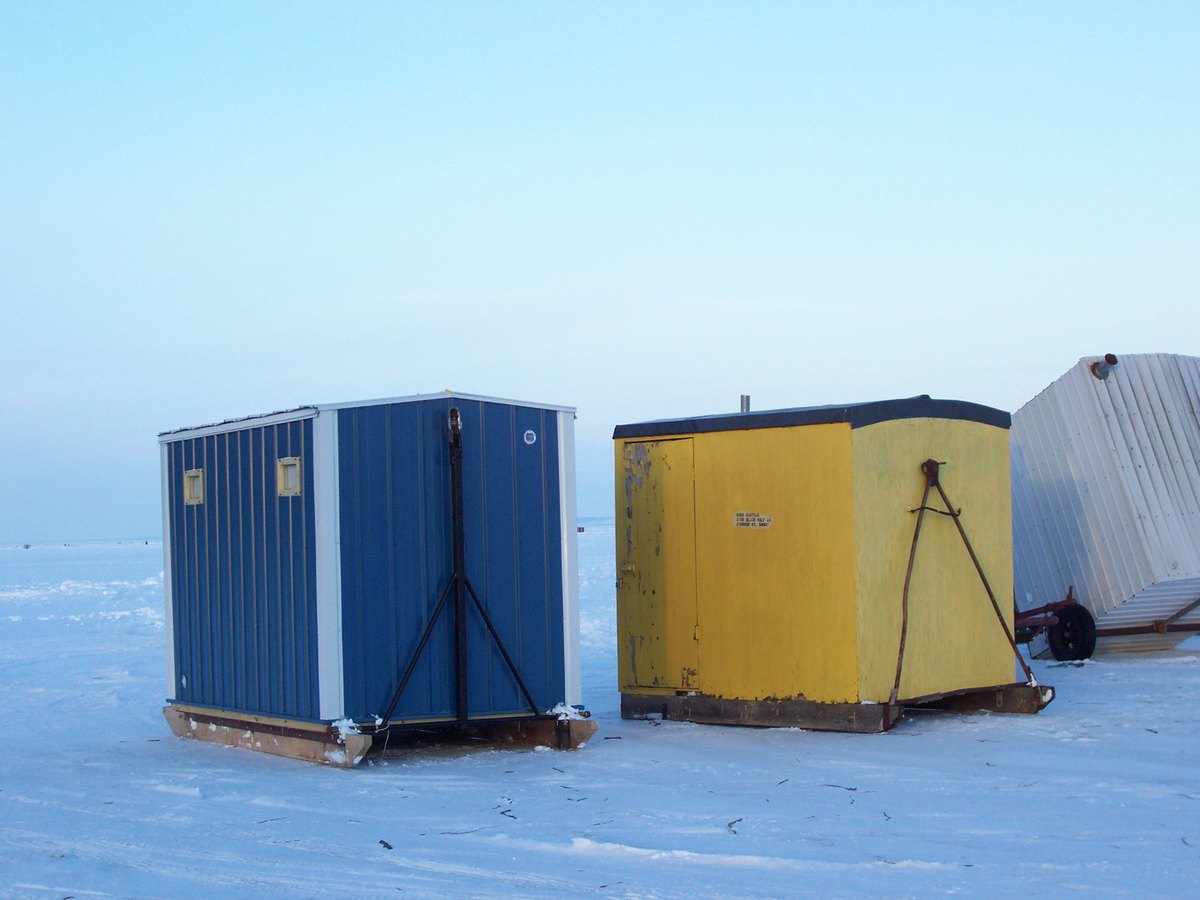
Shanties on the ice for the spear season. They come off before the ice does. Royal Broil via Wikimedia Commons (CC BY-SA 2.0) The season opens the second Saturday of February and runs a maximum of 16 days, with spearing hours of 7 a.m. to 1 p.m. and nothing outside them. A fish has to be at least 36 inches, the limit is one per licensee, and the carcass tag is validated immediately on harvest. The state's Winnebago System eRegulations page then goes on to govern the hole. Combined ice-hole area may not exceed 48 square feet measured at the ice surface, and the opening has to be marked with at least two strips of wood — an inch and a half wide, a quarter-inch thick — extending at least three feet above the ice. A spear may be no more than 18 inches wide, tines in a single straight line. Shanties come off the ice by the first Sunday following March 1.
What ends the season is the caps. Reaching 90 to 99 percent of any one of the three sex-specific caps triggers a 24-hour closure notice; hitting 100 percent closes it at the end of that day. In 2026 the season opened Feb. 14 and spearers took 1,029 fish over the opening weekend. The adult female cap was reached on Sunday, Feb. 22, and the season closed at 1 p.m. the next day — ten days into a 16-day window, the earliest close since 2015. The final count was 1,540 system-wide, 1,261 of them from Lake Winnebago and 279 from the Upriver Lakes. The DNR credited ice conditions, access and water clarity on opening weekend, after two straight years under 500 fish. On the last day, Bennett Glidden speared a 104.6-pound female and registered it at Quinney, and that was the last fish of the year.
Before you go: Licenses for Lake Winnebago are unlimited but must be bought by Oct. 31: $20 resident, $65 non-resident, minimum age 12 — with narrow exceptions for military personnel home on leave and for youth turning 12 between Nov. 1 and the last day of the season. The license and the carcass tag have to be carried on paper; a phone image, a receipt or a Go Wild card does not satisfy the rule. The Upriver Lakes are a separate lottery, 500 tags, applications due Aug. 1 and drawn in favor of the most preference points. Those are the DNR's figures for the 2026 season, from releases dated July 25 and Oct. 16, 2025; no 2027 schedule was published as of August 2026, so confirm before you buy anything.
Know what happened to the Sturgeon General
Winnebago and Calumet county courts, 2021
In 2017 the Wisconsin DNR, working with the U.S. Fish and Wildlife Service, opened an investigation into its own sturgeon program. Milwaukee Magazine describes 'a dragnet of about 20 agents, some of them working undercover.' The subject was caviar. Processors who cleaned speared sturgeon were keeping portions of the roe in lieu of payment, and DNR staff were passing caviar around at office meetings, potlucks and bars. A cooler at the Oshkosh DNR station was labeled with a processor's name. That processor supplied the department's lead sturgeon biologist, nicknamed the Sturgeon General, with 36 four- and eight-ounce jars in 2017.
Criminal complaints landed just before the February 2021 spearing season. The biologist pleaded no contest and was convicted in Winnebago County in June 2021 of resisting a conservation warden, then convicted again in Calumet County that July, where he was fined $500. His resignation from the DNR took effect July 22, 2021. Charges against a processor couple were conditionally dismissed. The June fine's amount is reported only by Milwaukee Magazine, so the Calumet figure is the only one printed here.
Read the water level as a decision, not a weather report
The dams at Menasha and Neenah
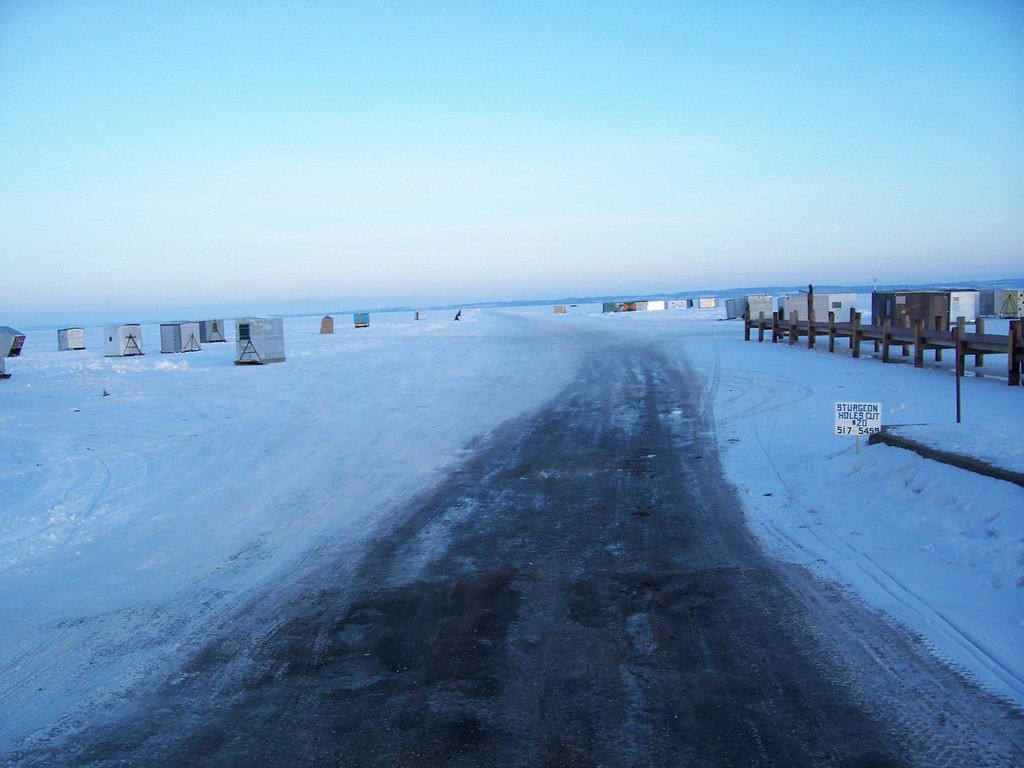
A plowed road out onto the ice, shanties either side of it. This is what the lake looks like in February. royal_broil via Flickr (CC BY-SA 2.0) Lake Winnebago's level has been federally regulated since 1886. Under the Federal Marshall Order of that year, modified in 1920 for navigation, the U.S. Army Corps of Engineers regulates the lake by controlling outflow at the dams in Menasha and Neenah. The Corps' Chicago District operates the Menasha dam and its six tainter gates; the Neenah dam — nine needle gates and five tainter gates — is privately owned and coordinated with the Corps. From May 1 to early October the level is held between 1.68 and 3.45 feet on the Oshkosh Datum, a band derived from the mean annual high-water stage over the 28 years from 1859 to 1886, measured as the average of gauges at Oshkosh, Stockbridge, Menasha and Fond du Lac.
Every winter the Corps draws the lake down to make room for snowmelt and spring rain and, in the Fox-Wolf Watershed Alliance's words, to help prevent destructive ice shoves. The shoves come anyway. On March 12, 2026, ice piled along the shoreline and towered near homes outside Oshkosh; one resident described 10 to 12 feet of ice building in 25 to 30 minutes, and another said it was the closest the ice had come to his house. Wayne Mueller told WBAY that shoves of that size arrive roughly once every 10 to 15 years. On March 22, 2022, a shove came ashore on Lake Rest Lane just south of Oshkosh, traveled about 10 feet into a residence and shattered a patio door.
Before you go: Outside the May 1 to early October navigation season the lake is deliberately held low, and the spring refill is gradual.
Walk a company town the state bought and turned into a park
High Cliff State Park
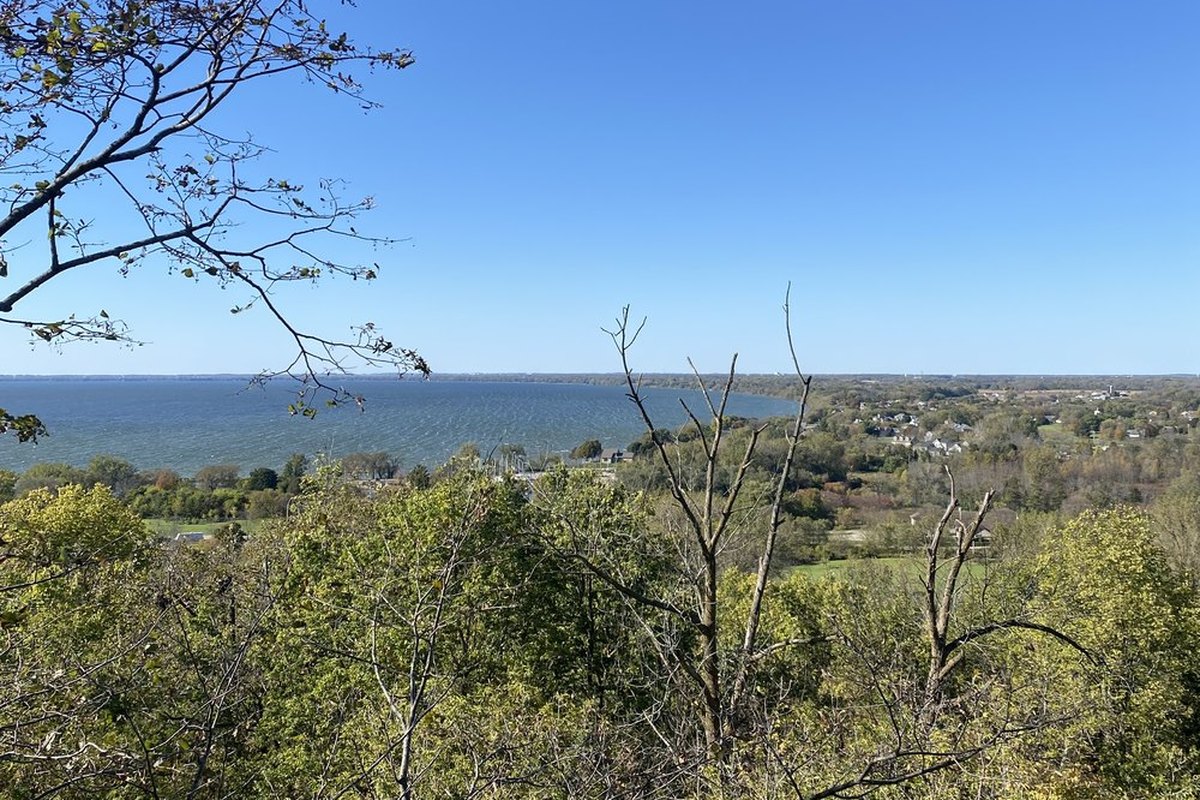
Lake Winnebago from the escarpment at High Cliff — the far shore is over the horizon. Clockman26 via Wikimedia Commons (CC BY-SA 4.0) From 1895 to 1956 the Western Lime and Cement Company quarried limestone here with dynamite and burned it in kilns, shipping lime across the Midwest for plaster, for cement and to cut the acidity of soil. As many as 40 people worked the operation, many of them recent immigrants from Hungary, and the company owned the village they lived in: 16 worker houses, a store and a tavern. The houses are gone. What survives is the ruins of the kiln and the store, which was built in 1855, held the post office, the telegraph office and the company office, and is a museum now. Wisconsin bought the land in 1956 and opened the park the following year.
Much older work sits on the same ground. The park's effigy mounds were built 1,000 to 1,500 years ago: four shaped as panthers, two as buffalo, plus conical mounds and a linear one. Some were first featured in Increase A. Lapham's 1855 'Antiquities of Wisconsin.' Six long-tailed effigies and several conical mounds can be seen along an interpretive trail, and they are the central portion of a group that was once more extensive.
A 12-foot statue erected in 1961, designed by Adolph E. Seebach, stands on a granite boulder overlooking the lake, labeled for the Winnebago chief Red Bird. That name is not the one the people it describes use. 'Winnebago' is an exonym, from a Potawatomi word rendered roughly 'Winnipego' and referring to stinking or salt water; the French took it up from Jean Nicolet's arrival in 1634 and it held for about 360 years. In November 1994, after a secretarial election approved a revised constitution, the tribe formally adopted its own name: the Ho-Chunk Nation. Wisconsin's Department of Public Instruction translates that as 'People of the Big Voice'; the Nation's own website renders it 'People of the Sacred Voice.' Ancestral territory ran from Green Bay past this lake to the Wisconsin River and down to the Rock River in Illinois, about 8.5 million acres under the 1825 treaty. The lake, the county, the city and the mental health institute all still carry the discarded name.
Before you go: The park is open 6 a.m. to 11 p.m. year-round and a vehicle admission sticker is required.
Put a boat in on the east shore, where the escarpment runs through the park
Calumet County Park, two miles northwest of Stockbridge
Calumet County Park Harbor has six launch lanes, room for vehicles and trailers, a toilet facility, bench seating and kayak rentals with an ADA kayak launch. Behind it the park runs 82 campsites and hiking and biking trails. The county's own park page and its tourism office are an acre apart on how much ground all of that sits on: 233 against 234.
The park also holds the Calumet County Park Group — six effigy mounds shaped as panthers and other water spirits, sited at the top of the Niagara Escarpment overlooking the lake and listed on the National Register of Historic Places on Dec. 29, 1997, reference number 97001551. Federal and state law restricts publication of their precise locations to prevent vandalism, so this page does not map them. The escarpment under them is the same formation that runs from eastern Wisconsin through Michigan's Upper Peninsula and southern Ontario to western New York. A post-Civil War brickyard site is on the property as well.
Before you go: Calumet County publishes the park's winter use as sledding, snow tubing, snowshoeing, cross-country ski trails, fat-tire bike trails and ice-fishing access. There is no downhill skiing here.
Have dinner inside a state sturgeon registration station
Supper clubW3496 County Road W, Malone, at Calumet Harbor in Pipe
Jim & Linda's Lakeview Supper Club appears on the DNR's 2026 Lake Winnebago station list as the Pipe station, which is to say that for up to 16 days beginning the second Saturday of February, the state counts speared sturgeon inside a prime rib and seafood restaurant that sits about 30 feet off the shoreline. The couple who own it bought the business in September 1978, aged 19 and 20, when it was still called Harry's Lakeview. Their first winter was slow. Then February arrived, and sturgeon season with it.
They bought the real estate in 1984 and remodeled to 65 seats. A large bar area added in 1988 took it to the 100 seats it holds now, up from a modified cottage that opened with five items on the menu. During spearing season they open early and serve breakfast to spearers heading out onto the ice.
The rest of the year it works as a lake stop rather than a station. The patio is boat-accessible in summer, with live music every weekend from Memorial Day weekend through mid-September by their own account; in winter it is reachable by snowmobile.
Before you go: Hours from their own site: Sunday 3 to 8:30, Tuesday through Thursday 4 to 9:30, Friday and Saturday 3:30 to 10, closed Monday. Reservations are accepted for groups of 10 or more, which makes a table for four on a Saturday a walk-in proposition. The menu detail here stops at prime rib and seafood on purpose; the longer dish list in circulation traces to a 2021 write-up we could not re-verify. 920-795-4116.
The fish fry that started at 99 cents
Supper clubN9699 Lakeshore Drive, Van Dyne, southwest shore
Wendt's on the Lake started as an icehouse in the early 1900s, supplying ice to the rural farming community around it. William Karpathian bought the building in 1942 and ran it as Karpathian's Tavern. Fritz and Cynthia Wendt bought it in 1962, made it Wendt's Bar and started the Friday fish fry with a 99-cent perch dinner served on folding tables. Their son and daughter-in-law, Mike and Linda Wendt, took over in 1978. Linda became sole proprietor in 1993 and added Saturday prime rib, BBQ pork ribs and batter-fried lobster. Her children are the third generation running it now, with a fourth generation involved.
Their own site puts fresh lake perch at the center of the operation. The complex is also part of the spearing system, though the DNR's 2026 registration list gives the station address as Wendt's Marine next door rather than the restaurant, so it is the property that carries the designation. During the season the schedule changes shape. February 2024 reporting had it open at 11 a.m. every day, Mondays included, and an owner told Spectrum News 1 (Feb. 11, 2026) the doors would open at 5 a.m. for the 2026 opening weekend.
Rumors that the place was closing circulated in early 2024. The owners publicly denied them on Feb. 6, 2024, and the business was confirmed operating in February 2026.
Before you go: Regular hours from their own site: Sunday 11 to 7, Tuesday through Thursday 11 to 8, Friday 11 to 9, Saturday 11 to 8, closed Monday. Reservations are accepted every day except Friday — the fish fry night, and the one night you cannot hold a table. (920) 688-5231.
Everything above is sourced and dated, and where the best source we found was a secondary one — the tower's height, the caviar dragnet, the amount of the June 2021 fine — the story says so on the line. That matters more than usual on this lake: the DNR reissues spearing fees, caps and season dates every year, and as of August 2026 there was no published 2027 schedule to check against. Supper club hours move too. If a number here has gone stale, tell us and we will fix the page.
All the data for Lake Winnebago — depth map, surveys, launches