LakeList
FavoritesStateWisconsin
Spring Lake
Enhanced dataHistorical depth chart
Spring LakePortage County, WI
Historical source depth chart available1 converted source DNR map sheet can be panned and zoomed in the browser. Interactive contours stay hidden until visual QA passes. Historical survey — not for navigation.
View browser depth chartLakeList assistant
Plan your lake day
Fishing spots, food, lodging, marinas, and rentals around Spring Lake.
Start here
Fishing forecast
Best windows for Spring Lake
Weather-based planning built from the National Weather Service hourly forecast near this lake.
Loading latest forecast…
Checking wind, precipitation, and near-term weather windows.
Water temperature
Spring Lake water temperature today
Modeled surface-temperature estimate built from seasonal climate, lake depth, and live National Weather Service air temperatures near this lake.
72°FWarm
Seasonal estimate. Checking current National Weather Service air temperatures…
Comfortable summer pattern. Bass and panfish are active; early and late hours beat the midday heat.
Estimates are modeled, not measured. Actual temperatures vary with depth, wind mixing, and recent weather — verify conditions before swimming, boating, or heading onto ice.
Wisconsin DNR water assessment
Impaired waterbody listed
The DNR lists this waterbody as impaired. This notice is not itself a closure; review the official assessment and current guidance before your trip.
303(d) / impairment recordRecreation restrictions noted
High Phosphorus LevelsPollutants: Total Phosphorus
- Status
- TMDL Approved
- Public health
- General Advice
- Recreation
- Recreational Restrictions
- Aquatic life
- Not specified
Water is impaired due to one or more pollutants and associated quality impacts.
Review DNR water quality Check consumption advice Source updated 2026-03-25 · LakeList verified 2026-07-12
DNR water check
Water quality quick take
From Wisconsin DNR / Citizen Lake Monitoring readings at Spring Lake - Deepest Spot.
Sampled Jun 2026Volunteer monitoring since 2011
Somewhat hazy water — summer clarity of 7.5 ft is clearer than most monitored Wisconsin lakes.
Based on July–August 2025 averages across 4 volunteer readings.54Eutrophic5-yr summer TSI
Nutrient-rich, greener water — more algae and plant growth, common in shallower lakes.
Water claritySecchi disk depth
7.5 ftJul–Aug 2025 avg (2 readings)
Slight hazeImproving — up ~24% vs earlier years
Clearer than 74% of 597 monitored Wisconsin lakes with current readings.
AlgaeChlorophyll-a
16 µg/LJul–Aug 2025 avg (2 readings)
ElevatedWorsening — up ~104% vs earlier years
No recent nutrient readings — last measured 2012.
Listed as impaired on the DNR/EPA water-condition assessment — see the notice on this page for details.All readings by year · station details · methodology
Summer averages (July/August)
July/August means; counts in parentheses show how many samples went into each average.
| Year | Secchi | Chlorophyll-a | Total phosphorus |
|---|---|---|---|
| 2025 | 7.5 ft (2) | 16.0 µg/L (2) | — |
| 2024 | 7.3 ft (2) | 24.5 µg/L (2) | — |
| 2023 | 11.0 ft (2) | 7.5 µg/L (2) | — |
| 2022 | 8.0 ft (2) | 19.5 µg/L (2) | — |
| 2016 | 6.5 ft (2) | — | — |
| 2015 | 6.3 ft (2) | 1.0 µg/L (1) | — |
| 2014 | 6.3 ft (2) | 3.0 µg/L (2) | 16.0 µg/L (1) |
| 2013 | 9.3 ft (2) | 16.5 µg/L (2) | — |
| 2012 | — | 15.3 µg/L (3) | 26.3 µg/L (3) |
| 2011 | 7.3 ft (6) | — | — |
Latest individual samples: Secchi 13 ft (2026-06-22), chlorophyll-a 14 µg/L (2025-08-27), and total phosphorus 34 µg/L (2015-05-28).
Secchi clarity is how deep a black-and-white disk stays visible from the surface — more feet means clearer water.
Chlorophyll-a is an algae pigment; higher values signal more algae in the water column.
Total phosphorus is a nutrient that feeds algae and aquatic plants. It is not a weed survey — depth, bottom type, water movement, and management change the actual lake experience.
Spring Lake - Deepest SpotStation 503141 · TSI based on chlorophyll
Modeled from DNR/CLMN monitoring — not a safety or swim-condition report. Verify current conditions locally. LakeList verified 2026-07-12.Official Wisconsin information
Plan with DNR sources
LakeList links to the authoritative record so you can verify maps, rules, and current notices before leaving.
Historical DNR depth maps1 converted map sheetFishing regulationsVerify current seasons, limits, and restrictionsOfficial DNR lake pageFacts, advisories, boating, and water qualityWater quality reportsMonitoring stations, clarity, and DNR reportsInvasive speciesVerified, observed, and historical AIS recordsBoating ordinancesLocal slow-no-wake and water-use restrictionsFish consumption advisoriesStatewide and waterbody-specific health guidance
Historical depth maps are not for navigation. Verify regulations and access at the official source before your trip.
Historical Wisconsin DNR maps
Spring Lake depth maps
1 converted map sheet. These historical surveys are not for navigation.
Navigable depth map
Spring Lake · sheet 1
Pan, zoom, and inspect the converted Wisconsin DNR historical map image in the browser. Historical survey — not for navigation.
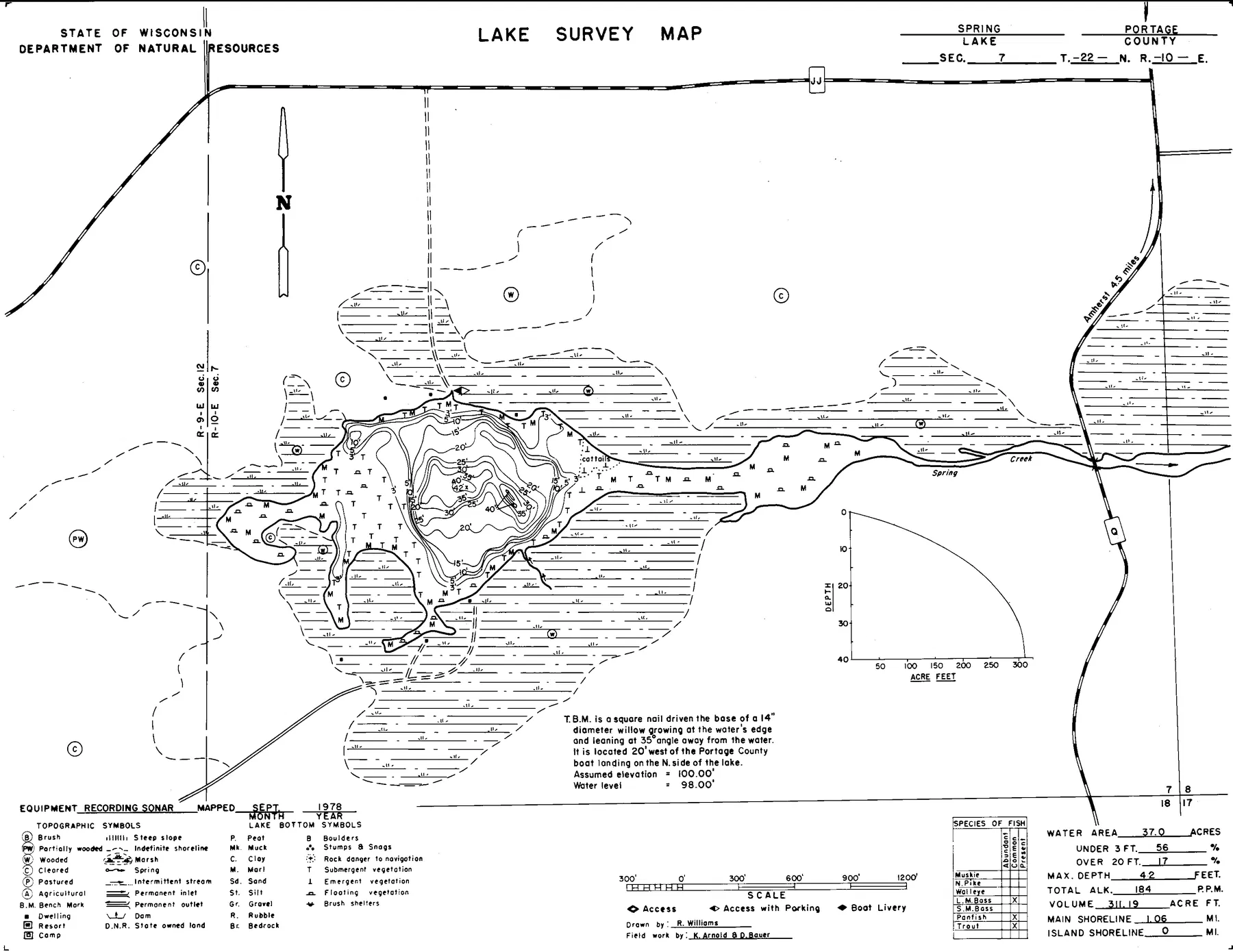
Source: Wisconsin DNR · WBIC 267200 · image navigation only; spatial alignment pending · Historical lake maps are not for navigation.
Source: Wisconsin Department of Natural Resources. Converted for browser access with source URLs, checksums, and retrieval dates retained. Historical lake maps are not for navigation.
38surface acres
42max depth feet
2public access points
44.3941, -89.3388latitude, longitude
Access
Public access points
Boat launchAccess44.39554, -89.33980Managed by Wisconsin DNR
DNR verifiedDirections
Boat launchSpring Lake Access South44.39246, -89.33980Managed by STATE(DNR)TOWN OF LANARKRamp surface: GravelADA-accessible feature: NoVerified 2026-07-12
Nearby
Trip-planning places
No nearby trip-planning places yet
Fishery
Notable species
Largemouth BassPanfishTrout
Wisconsin DNR stocking
Fish stocking history
The latest published year is 2025, when 2,730 fish were recorded across 1 entry.
2025
Rainbow TroutErwin · Yearling
2,7309.1 in average
2024
Rainbow TroutErwin · Yearling
2,3338.9 in average
2023
Rainbow TroutErwin · Yearling
2,4818.5 in average
2022
Rainbow TroutErwin · Yearling
1,9358.8 in average
2021
Rainbow TroutErwin · Yearling
2,4808.4 in average
2021
Rainbow TroutErwin · Yearling
6009.0 in average
2020
Rainbow TroutErwin · Yearling
1,2928.5 in average
2019
Rainbow TroutErwin · Yearling
1,3398.6 in average
2018
Rainbow TroutErwin · Yearling
1,1898.5 in average
2017
Rainbow TroutErwin · Yearling
1,1789.7 in average
2016
Rainbow TroutErwin · Yearling
4379.1 in average
2015
Rainbow TroutErwin · Yearling
9869.4 in average
Showing the 12 most recent records from 17 published entries.
Depth FAQ
How deep is Spring Lake?
Spring Lake is 42 feet deep at its deepest point and averages about 8 feet, according to Wisconsin DNR records.
Is there a free depth map of Spring Lake?
Yes. 1 scanned Wisconsin DNR lake survey map sheet is free to view and zoom on LakeList. These historical surveys are not for navigation.
Where does the Spring Lake depth map come from?
The map sheets are converted from official Wisconsin DNR lake survey documents, with the source URL, checksum, and retrieval date retained for every sheet. Historical surveys are not for navigation.
Trust and freshness
Where this lake data comes from
Wisconsin DNR Lake Pagesname, coordinates, county, source identifiers
LakeList record updated 2026-05-25